تمت ترجمة هذا النص بواسطة الذكاء الاصطناعي وقد يحتوي على أخطاء.
تخطي إلى المحتوى

الأبحاث والتعليقات

اقرأ الأبحاث والتحليلات والتعليقات المتعمقة من زملاء وخبراء معهد الشرق الأوسط عن الشرق الأوسط. 

Trump’s South Caucasus Peacemaking Is His Most Successful, but It Remains Unfinished
  • تعليق
  • Trump’s South Caucasus Peacemaking Is His Most Successful, but It Remains Unfinished

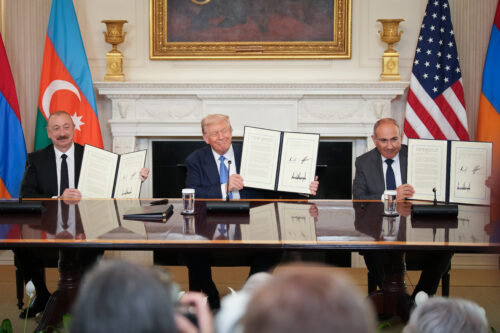
    Of all the fronts in President Trump’s peacemaking agenda, the South Caucasus has delivered the most concrete results. The August 2025 Washington Declaration, signed between Armenia and Azerbaijan and witnessed by Trump, marked an important step toward peace in the region. The two sides initialed a peace agreement and advanced plans to unblock regional connectivity, including through the establishment of the Trump Route for International Peace and Prosperity (TRIPP), which would connect Azerbaijan to its Nakhijevan exclave through southern Armenia. Implementation of TRIPP has since made notable progress, but construction has yet to start. A breakthrough on those two tracks would, in turn, unlock Armenia–Türkiye normalization, transforming a long-fractured region into an area of trade and interdependence.
    The Iran War Was Always About Regime Change
  • تعليق
  • The Iran War Was Always About Regime Change

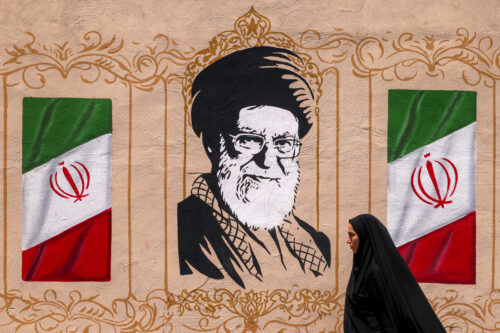
    Wars don’t just end. They get interpreted, reinterpreted, and turned into strategic doctrine. That is what happened after the Iran-Iraq War of the 1980s, a conflict that saw the United States back Tehran’s Iraqi adversaries. The war taught Tehran three lessons it never unlearned: that Washington wants the Islamic Republic gone, that Iran stands essentially alone in the world, and that it cannot survive a direct, overt fight with the U.S. and Israel.

    Iran’s New War Cabinet Is Really an Old One
  • التحليل
  • Iran’s New War Cabinet Is Really an Old One

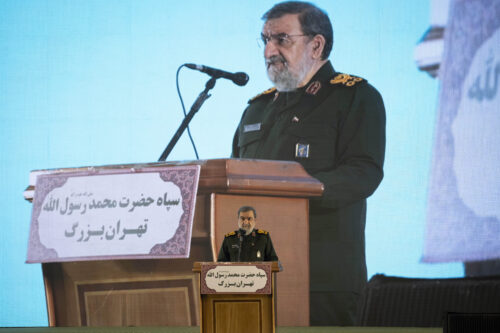
    Within 48 hours this week, Iran filled six of the most important posts in its battered military and security establishment. Read together with the biographies and mandates behind them, the appointments show how Tehran is drawing lessons from successive wars and preparing for a prolonged period of insecurity, without proving it has abandoned negotiation.

    Additional Research & Commentary

    معلومات أساسية

    Israeli Settlements in the West Bank
  • معلومات أساسية
  • Israeli Settlements in the West Bank

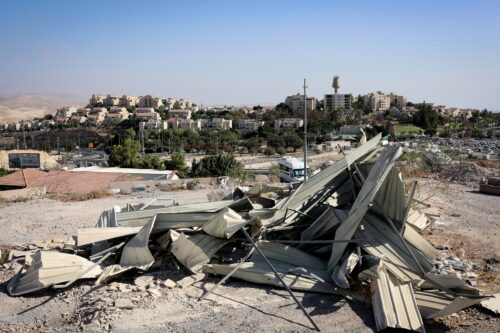
    Since 1967, Israeli settlements in the West Bank have been a contested feature of the Israeli-Palestinian conflict. The ultimate disposition of the settlements and ongoing activity related to their growth have repeatedly defied agreement in negotiations over a resolution to the conflict.

    June 9, 2026

    The Houthis
  • معلومات أساسية
  • The Houthis

    The Houthis are a political-military faction and Zaydi religious movement founded in northwestern Yemen in the 1980s. A key member of Iran’s Axis of Resistance with links to other militant organizations in the Arabian Peninsula and the Horn of Africa, the group has continued to pose a threat to Western interests on a global scale.

    May 15, 2026

    The India-Middle East-Europe Economic Corridor
  • معلومات أساسية
  • The India-Middle East-Europe Economic Corridor

    The India-Middle East-Europe Economic Corridor (IMEC) is a proposed multinational infrastructure initiative aimed at upgrading connectivity between the three regions through integrated trade, energy, and digital networks. Announced at the G20 summit in New Delhi in September 2023, IMEC is envisioned partially as a counterweight to China’s international infrastructure project, the Belt and Road Initiative.

    June 3, 2026

    Turkish Foreign Policy
  • معلومات أساسية
  • Turkish Foreign Policy

    After a decade of post-Arab Spring isolation, Turkey’s leaders have recognized that their ambition to position the country as an agenda-setter on the world stage requires active engagement in all directions. President Recep Tayyip Erdoğan’s consolidation of executive authority has centralized foreign policy decision-making and tied it to his domestic political priorities, transforming the country’s revisionist approach to one shaped primarily by personal and pragmatic interests.

    April 23, 2026

    المدونات الصوتية

    التركيز على الشرق الأوسط

    البودكاست الأسبوعي الرائد لمعهد الشرق الأوسط حول السياسة الخارجية الأمريكية والقضايا السياسية والاجتماعية المعاصرة في الشرق الأوسط.

    إزالة الحافة من الشرق الأوسط

    براين كاتوليس، زميل أول في معهد الشرق الأوسط كاتوليس يشارك الأصدقاء والزملاء وخبراء السياسة في محادثات غير رسمية حول أهم الأحداث في الشرق الأوسط. 

    إعادة التفكير في الديمقراطية

    زميل أول في معهد الشرق الأوسط غونول تول تستضيف كبار العلماء وقادة الفكر حول اتجاهات الديمقراطية العالمية وحالة النظام الدولي الليبرالي. 

    تصفية حسب
    8783 Results
    Sectarian Violence Involving Rohingya in Myanmar: Historical Roots and Modern Triggers
    معهد الشرق الأوسط
  • التحليل
  • Sectarian Violence Involving Rohingya in Myanmar: Historical Roots and Modern Triggers

    While the tangled roots of the Rohingya have played a critical role in the recent inter-religious violence between Rohingya and Buddhists, so too has the rise of Burman-Buddhist ethno-nationalism. This essay discusses the the salient narratives driving anti-Rohingya/anti-Muslim sentiments as well as the policies and reforms that have contributed to prolonging the violence.

    August 4, 2014

    War in Gaza: A chance for Iran, Hamas to turn a page?
  • التحليل
  • War in Gaza: A chance for Iran, Hamas to turn a page?

    Read full article on CNN.

    Israel’s ongoing military operation in Gaza — Protective Edge — has animated the Shia Islamist leadership in Tehran.

    The bloody conflict, and the global Muslim outrage it has provoked, is held by the Iranian regime as a chance to redeem itself in the eyes of the Sunni Muslim majority in the world.

    Democracy Cannot Exist without Social Cohesion: The Myanmar Challenge
  • التحليل
  • Democracy Cannot Exist without Social Cohesion: The Myanmar Challenge

    By emphasizing uniformity through laws to protect one class of race and religion, Myanmar legislators are advancing a device for oppression. If enacted, the Law on Protection of Race and Religion would not only breach international conventions; it would also preset the conditions for further sectarian violence.

    July 30, 2014

    Salafism and the Persecution of Shi‘ites in Malaysia
    معهد الشرق الأوسط
  • التحليل
  • Salafism and the Persecution of Shi‘ites in Malaysia

    In the last few decades, religious scholars have branded many age-old Malay and Sufi religious practices as wrongful innovations. One of the great casualties of this rising intolerance has been Shi‘ism, whose followers have received some of the most intense criticism. It is widely accepted that these developments have much to do with the rise of Salafism.

    July 30, 2014

    El-Sisi’s Predicament with the Gaza Crisis
    معهد الشرق الأوسط
  • التحليل
  • El-Sisi’s Predicament with the Gaza Crisis

    The current crisis in Gaza represents the first real foreign policy test for Egyptian president Abdel Fattah el-Sisi.  Hamas’s rejection of the Egyptian initiative to end hostilities calls into question Egypt’s ability to maintain its decades-long special status as mediator, a role it assumed by virtue of its relations with all parties – Israel and the United States on one hand, and the PLO and Hamas on the other.

    July 30, 2014

    Gaza Crisis Shows Turkey’s Declining Regional Influence
    معهد الشرق الأوسط
  • التحليل
  • Gaza Crisis Shows Turkey’s Declining Regional Influence

    The Israeli incursion into Gaza and the ensuing diplomatic efforts to end the violence have revealed Turkey’s waning influence in the region.  

    The Turkish government has been promoting itself as a potential mediator between Israel and Hamas.  The latter’s rejection of an Egyptian ceasefire in mid-July bolstered Turkey’s hopes of playing a key role, as did its inclusion in this past weekend’s Paris summit hosted by U.S. Secretary of State John Kerry.

    Malaysia and its Shi‘a “Problem”
    معهد الشرق الأوسط
  • التحليل
  • Malaysia and its Shi‘a “Problem”

    The primacy of ethnic Malays (and by association their adherence to Sunni Islam) has meant that Shi‘i Islam is considered a “deviant” sect in the country. Although official spokespeople regularly claim that the state has no concerns about Shi’a practicing their faith as long as they refrain from proselytizing, adherents face both social and legal restrictions.

    July 25, 2014

    The Future of Tunisia's Nidaa Tounes Party
    معهد الشرق الأوسط
  • التحليل
  • The Future of Tunisia's Nidaa Tounes Party

    When the Nidaa Tounes (“Call for Tunisia”) party was formally licensed in July 2012, it positioned itself as a “modern” alternative to the Islamist Ennahda party. Led by former interim prime minister Béji Caid Essebsi, Nidaa Tounes drew a wide range of people, including supporters of Tunisia’s Destourian (“Constitution”) movement, trade unionists, leftists, and independents, as well as former members of Zine el-Abidine Ben Ali’s Constitutional Democratic Rally (RCD) party.

    July 25, 2014

    Egypt’s Least Bad Option for Addressing Energy Troubles
    معهد الشرق الأوسط
  • التحليل
  • Egypt’s Least Bad Option for Addressing Energy Troubles

    A proposed deal to export Israeli natural gas through Egypt has the potential to enable Israel’s entry into its first major export markets, help Egypt escape a deepening energy crisis, and welcome the first European players into Israel’s natural gas industry. However, the deal is complicated by political realities and a history of deeply rooted grievances between the two countries, made worse by the recent violence between Israel and Hamas in Gaza.

    July 24, 2014

    Shi‘a-Inspired Violence in Malaysia: A Possibility?
    معهد الشرق الأوسط
  • التحليل
  • Shi‘a-Inspired Violence in Malaysia: A Possibility?

    Ever since the triumph of Iranian Shi’a revolutionaries against the shah in 1979, the Malaysian government has been wary of the dangers of the revolution being exported across its borders. The author argues that rather than oppressing and vilifying indigenous Shi‘a citizens, the state should engage them intellectually, socially, and perhaps even religiously, in the spirit of Prime Minister Najib Razak.

    July 24, 2014

    Why the U.S. Has Limited Options In Iraq
  • التحليل
  • Why the U.S. Has Limited Options In Iraq

    When US commanders in Iraq in 2006 were trying to figure out the best way to approach the burgeoning insurgency, two points of view emerged from the debate. 

    July 24, 2014

    اقرأ مجلة الشرق الأوسط

    تُعد المجلة الرئيسية لمعهد الشرق الأوسط أقدم مطبوعة محكّمة مكرّسة لدراسة الشرق الأوسط الحديث، وتغطي المجلة الرئيسية في المعهد السياسة والمجتمع والثقافة في المنطقة.