Security cooperation has been a critical pillar of U.S. statecraft for decades. However, the enterprise has gotten a bad reputation since the beginning of the 21st century because of the costly misadventures in Afghanistan, Iraq, Syria, and elsewhere. But perhaps the problem is that we are not evaluating it the right way.
Much of Washington’s frustration with security cooperation is warranted, but some of it also is misplaced. Any sound assessment of security cooperation’s return on investment should start with a clear understanding of the intended objectives of the security cooperation program, and whether those, and only those, are effectively being met. Underscoring the difference between the process of security cooperation and the strategic/policy outcomes of security cooperation is also crucial for evaluators. Each deserves its own distinct evaluation. The United States has sometimes succeeded with the former only to struggle with the latter due to various external factors that have little or nothing to do with security cooperation itself.
Correctly evaluating security cooperation — a responsibility that ultimately belongs to the Office of the Under Secretary of Defense for Policy — matters a great deal because the stakes are currently so high. In a period of strategic competition with China, America’s global network of allies and partners is a unique advantage that should be leveraged and sustained through a better understanding of, and a larger role for, security cooperation. Better assessment would help to ensure that Washington does not abandon or reduce its reliance on this crucial tool when it’s needed most. Better assessment could also help U.S. policymakers to think more strategically about the political pitfalls that undermine security cooperation, so they better pre-empt them and deploy this tool when and where it will be most effective.
The Middle East Institute (MEI) is an independent, non-partisan, not-for-profit, educational organization. It does not engage in advocacy and its scholars’ opinions are their own. MEI welcomes financial donations, but retains sole editorial control over its work and its publications reflect only the authors’ views. For a listing of MEI donors, please click here.
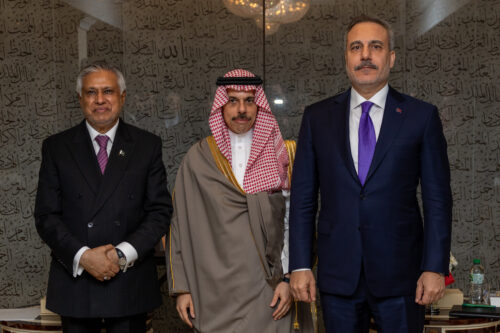
The Mecca Joint Défense Agreement: A New Geometry of Middle Eastern Power?