From the Middle East to Middle America: Engineering Better Policy with Andrew J. Tabler
Brian sits down with Andrew J. Tabler, the Martin J. Gross Senior Fellow in the Linda and Tony Rubin Program on Arab Politics at The Washington Institute, to trace his unique and distinctive path from Oil City, Pennsylvania, to fourteen years living and working in the Middle East. Tabler discusses his time in Syria under the Assad regime, his service as director for Syria at the National Security Council and as senior advisor to the Special Envoy for Syria Engagement at the US State Department’s Bureau of Near Eastern Affairs in the first Trump administration, and explains how these experiences shaped his perspective and inspired him to found the Drake Energy Forum.
Special Episode: Saudi Oil After the East-West Pipeline Attack
Saudi Arabia’s East-West pipeline is back in operation after a drone attack from Iraq, blamed on Iran-backed militias, shut it down for nearly two weeks. The pipeline is the kingdom’s main way to export oil while the Strait of Hormuz is closed, so the shutdown dealt another blow to global energy markets. How vulnerable is this route, and what does that mean for the kingdom and the world economy? This episode of Middle East Focus features a recent MEI Virtual Briefing in which Director of Communications Zeina Al-Shaib is joined by MEI Senior Fellow Colby Connelly and MEI Affiliate Yesar Al-Maleki. They examine the new geopolitical risks facing the oil market, what further losses of global supply could mean for Saudi Arabia and the world economy, and which buffers outside the Persian Gulf could ease the pressure.
The Mecca Joint Défense Agreement: A New Geometry of Middle Eastern Power?
On August 7, 2026, Saudi Arabia, Turkey, and Pakistan signed the Mecca Joint Défense Agreement, a collective-defense pact widely compared to NATO’s Article 5. This essay argues that the comparison is misleading. Mecca borrows NATO’s language of solidarity without yet possessing NATO’s institutional machinery, and the Houthi offensive against Saudi Arabia in September 2026 provided an early and revealing test of what the agreement actually means in practice. Neither Pakistan nor Turkey automatically entered the fight on Saudi Arabia’s behalf, and Washington, despite an initial reluctance to strike directly, remained indispensable through intelligence support and a major proposed F-35 sale. Drawing on realist alliance theory — Hans Morgenthau, Kenneth Waltz, Stephen Walt, Glenn Snyder, and Steven David — and on the precedent of the Central Treaty Organization (CENTO), the essay contends that the Middle East is not dividing into rival blocs but moving from hierarchy toward a looser, overlapping geometry of hedged partnerships, in which American exclusivity is eroding considerably faster than American primacy.
The Mecca Alliance Meets the Red Sea – Saudi Arabia’s New Defense Pact Faces Its First Major Test
When Saudi Arabia, Turkey and Pakistan agreed to a mutual defense pact in August, it was principally seen as a political commitment. The “Mecca alliance,” as it was dubbed, stipulated that an armed attack on one would be treated as an attack on all three, accompanied by deeper military cooperation.
When the US and Israel launched military action against Iran on February 28, 2026, it set in motion a chain of events that saw violence spread across the Middle East. Yet as the region found itself engulfed in conflict, Syria has experienced its most peaceful months in 15 years, and the government in Damascus appears determined to stay its course toward recovery.
Unlocking the Levant: Why the United States and Syria Must Pursue a Bilateral Trade and Investment Agreement
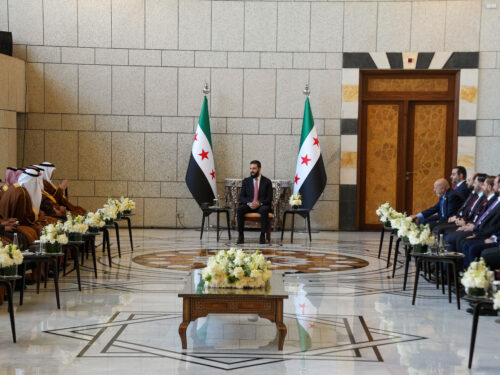
Apart from the brief honeymoon period between 1961 and 1963 under President John F. Kennedy and President Nazim al-Qudsi, US-Syria relations have never held such optimistic potential as they do today. Today, following the fall of Bashar al-Assad regime and the rise of a new government under President Ahmad al-Sharaa at the end of 2024, a new geopolitical window has opened.
Though it has fallen out of the headlines because of the Iran war, Syria has had a dramatically consequential summer. Hosts Alistair Taylor and Matthew Czekaj are joined by MEI Senior Fellow Charles Lister to take stock of recent developments: the dissolution of the Kurdish-led Syrian Democratic Forces, Israeli strikes and the friction with Turkey they have exposed, the standoff in Sweida, as well as Damascus’s bid to turn Syria into a trade corridor between the Mediterranean and the Gulf. Is the transition consolidating or fragmenting nearly two years after the fall of the Assad regime?
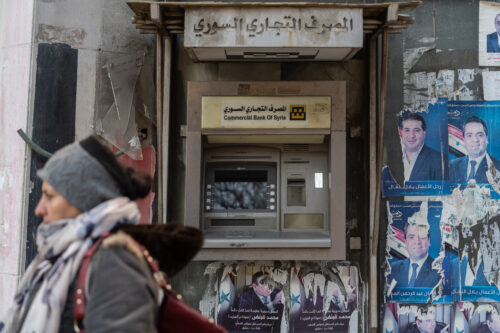
With sanctions repealed, Syrian policymakers must ensure that growing volumes of credit reach beyond the narrow political and commercial networks that have generally dominated Syrian finance. That will require a credit strategy aimed at sectors and regions historically excluded from formal finance. Syria’s specialized state banks offer an imperfect but ready-made mechanism to do so.
Saudi Arabia’s approach to the Iran war has been defined by a sustained effort to avoid direct entanglement. That restraint was notable given Riyadh’s position as Iran’s principal Gulf rival, its close security relationship with Washington, and its exposure to regional escalation. The kingdom made clear that it would not permit its territory or airspace to be used by any party for military action against Iran, avoided rhetorical alignment with Israel, and preserved the diplomatic channels with Tehran that were restored in 2023.
In many ways, the U.S.-Israeli war against Iran and the war in Gaza that preceded it seem transformative. After decades of shadow warfare, Iran and Israel have now attacked each other’s homelands directly. And Israel and the United States have joined forces in a genuinely novel way to wage war against Iran.
US President Donald Trump recently proposed that Syria intervene militarily against Hizballah in Lebanon. Is that a good idea? This episode of Middle East Focus features a recent MEI Virtual Briefing. Director of Communications Zeina Al-Shaib is joined by Ambassador David Hale, MEI Distinguished Diplomatic Fellow and Charles Lister, MEI Senior Fellow. Together they examine the prospects and implications of renewed Syrian involvement in Lebanon, the potential impact on US relations with both countries, and how evolving dynamics in Lebanon and Syria could reshape the regional balance of power and affect countries such as Turkey and Israel.
After the US-Israel-Iran war — and the strikes that followed the cease-fire — the Gulf states find themselves dangerously exposed. Host Alistair Taylor is joined by MEI Associate Fellow Gregory Gause to discuss the war’s impact on the Gulf, their partnership with the United States, and whether the turmoil of recent months will push Gulf leaders to reassess their alliances and international engagement.
The Gulf’s Strategic Paradox: Lost Confidence in the US Security Umbrella, Enduring Trust in the Dollar
This essay argues that the current debate about the future of the international monetary system is not really about Gulf currencies, oil pricing, or de-dollarization in the narrow technical sense. It is about something deeper and more important: whether institutional trust can survive when geopolitical certainty is eroding.
Syria’s Energy Revival and the Gulf’s Strategic Opening
Syria’s shattered energy sector is being rebuilt at a moment of unusual strategic flux across the Middle East, one defined by Iran’s military degradation following sustained U.S. and Israeli strikes in February and March; Russia’s prolonged absorption in its war in Ukraine; and China’s preference for commercial caution over political risk. Together, these shifts have weakened or distracted the external powers that once dominated Syria’s trajectory. The Gulf states have moved in to decisively fill the opening.