This report explores maritime security conditions in the Mediterranean and the evolving US engagement in the region. As critical infrastructure becomes increasingly vulnerable to sabotage, freedom of navigation is undermined by conflict, and energy disputes generate tension, US policy focus on the region has become fragmented and disengaged. The authors call for a sustained American role to strengthen maritime domain awareness, allied coordination, infrastructure protection, and the capacity to respond when Mediterranean crises affect US and transatlantic interests.
The Multiple Costs of the US–Iran War – From Hormuz to Europe and South Asia: The Widening Economic and Political Geography of the Conflict
Wars are decided by those who hold military power, but their costs are increasingly borne by those who have little or no voice in the decisions that start them. The US–Iran war shows this imbalance very clearly. Its economic consequences have gone far beyond the battlefield and have disrupted energy markets, trade routes, food supplies, public finances and investment in the Gulf, Europe, Africa and Asia. The most striking feature of the conflict, however, is not only the size of the damage but its very unequal distribution.
In less than two decades, a string of offshore discoveries has turned the Eastern Mediterranean into a significant gas-producing region, making Israel an exporter, twice lifting Egypt into the ranks of liquefied natural gas (LNG) exporters, and giving Cyprus finds it has yet to bring to market. This backgrounder explores the potential and challenges of exploiting and managing LNG resources in the region.
Many participants and leaders of the January 25 revolution hoped for a new Egypt to emerge, one that respected freedom of speech and freedom of religion, amongst other liberties. More than two years later, it has become glaringly obvious that such hopes were pipe dreams, and that the “New Egypt” will respect neither, in part thanks to the mounting number of blasphemy cases and trials that have taken place.
Egypt is in trouble. And Egypt’s trouble is bad news both for Egypt and for the United States. With a withering economy, continued political unrest, and poor institutionalization of new and ever-evolving political rules, many Egyptians have lost hope in the ultimate success of the country’s political transformation. Given the sacrifices and optimism associated with the removal of President Hosni Mubarak in 2011, the failure of governance in Egypt, though not entirely unexpected, has the makings of tragedy.
The Middle East Institute is pleased to welcome Sarah Margon of Human Rights Watch and Nancy Okail of Freedom House for a timely discussion about the implications of Egypt’s controversial draft NGO law submitted for vote to the Shura Council last week. The law, which seeks to restrict the funding and operation of non-governmental organizations, is being slammed by human rights groups both inside Egypt and around the world as a blow to the free and full expression of Egyptian civil society.
The Middle East Institute is pleased to welcome Sarah Margon of Human Rights Watch and Nancy Okail of Freedom House for a timely discussion about the implications of Egypt’s controversial draft NGO law submitted for vote to the Shura Council last week. The law, which seeks to restrict the funding and operation of non-governmental organizations, is being slammed by human rights groups both inside Egypt and around the world as a blow to the free and full expression of Egyptian civil society.
The Middle East Institute is pleased to welcome Sarah Margon of Human Rights Watch and Nancy Okail of Freedom House for a timely discussion about the implications of Egypt’s controversial draft NGO law submitted for vote to the Shura Council last week. The law, which seeks to restrict the funding and operation of non-governmental organizations, is being slammed by human rights groups both inside Egypt and around the world as a blow to the free and full expression of Egyptian civil society.
The Middle East Institute is pleased to welcome Sarah Margon of Human Rights Watch and Nancy Okail of Freedom House for a timely discussion about the implications of Egypt’s controversial draft NGO law submitted for vote to the Shura Council last week. The law, which seeks to restrict the funding and operation of non-governmental organizations, is being slammed by human rights groups both inside Egypt and around the world as a blow to the free and full expression of Egyptian civil society.
The Middle East Institute is pleased to welcome Sarah Margon of Human Rights Watch and Nancy Okail of Freedom House for a timely discussion about the implications of Egypt’s controversial draft NGO law submitted for vote to the Shura Council last week. The law, which seeks to restrict the funding and operation of non-governmental organizations, is being slammed by human rights groups both inside Egypt and around the world as a blow to the free and full expression of Egyptian civil society.
It was with customary gusto that Egyptian President Mohamed Morsi proudly announced that he had submitted his first draft law to the Shura Council under the new constitution that came into effect in December of 2012.
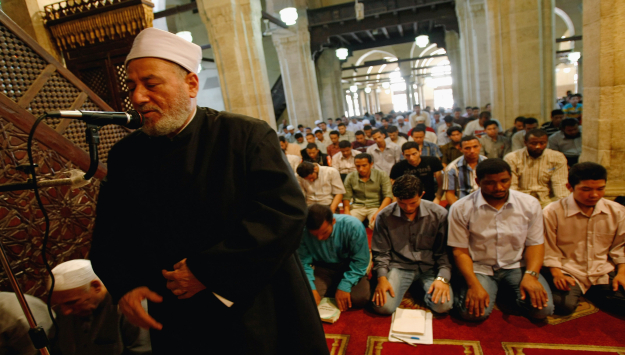
From Muhammad Ali to Mohamed Morsi, modern Egyptian leaders have understood that any attempt to control the state without the endorsement, if not blatant co-option, of key institutions such as al-Azhar is an ill-fated pursuit. The headache for President Morsi is that these institutions are trying to assert their independence and are presenting a range of direct and indirect challenges to his authority and, more broadly, to the Muslim Brotherhood and its political arm, the Freedom and Justice Party (FJP).
The oldest peer-reviewed publication dedicated to the study of the modern Middle East, MEI’s flagship journal covers politics, society, and culture in the region.