Operationalizing the Trilateral Framework Agreement
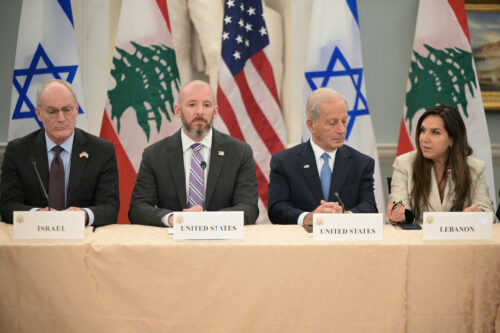
As part of a report outlining an actionable US roadmap to win in Lebanon, this article analyzes the Tripartite Framework Agreement signed by representatives of the United States, Israel, and Lebanon, and compares previous US-led peacekeeping mechanisms.
As part of a report outlining an actionable US roadmap to win in Lebanon, this article discusses the role of the United States in defeating Hizballah and achieving a permanent end to the conflict between Lebanon and Israel.
Hizballah’s Deep State: The Real Challenge of Disarmament in Lebanon
As part of a report outlining an actionable US roadmap to win in Lebanon, this article argues that to strengthen the Lebanese state, accelerate economic recovery, and permanently reduce Iran’s influence, the United States should support efforts to dismantle Hizballah’s financial networks, political influence, and parallel institutions as well as reform the judicial system.
From Player to Referee: Dismantling the Culture of Entitlement and Cartelization in Lebanon
As part of a report outlining an actionable US roadmap to win in Lebanon, this article calls on the international community to focus on helping Lebanon transition from a market participant to a neutral Referee, strictly enforcing competition and the rule of law across both the public and private sectors.
Owning the Recovery: Supporting Lebanese-Led Reconstruction Without Repeating the Past
As part of a report outlining an actionable US roadmap to win in Lebanon, the author analyzes previous international donor strategies in Iraq, Lebanon, and Ukraine as Washington and its Gulf partners consider how to assist the new Lebanese government in crafting and implementing a national recovery plan.
Trump’s Family Business Deals Risk Further Undermining the Credibility of US Middle East Policy
President Trump’s family businesses are once again in the spotlight as a new financial disclosure showed they earned $2 billion in income in 2025 — a dramatic increase on the year before, with much of it coming from Gulf entities, raising emoluments concerns. Mounting perceptions of corruption, combined with unresolved crises in Iran and Israel-Palestine, are eroding trust among key partners in the Middle East. With the 2026 midterms approaching, these entanglements could represent a major political vulnerability and further undermine America’s already-strained standing in the region.
The Other MoU: Launching a Europe-Gulf Resilience Initiative After the US-Iran Deal
The Islamabad Memorandum of Understanding (MoU) between the United States and Iran may have ended one of the most consequential Middle Eastern crises in decades, but it has not resolved the strategic problem it exposed. Whether the 60-day talks it set in motion will produce a final agreement remains far from certain.Yet the central lessons are already clear: Iran has preserved significant leverage, Washington has had to scale back its ambitions, and Europe and the Gulf face the prospect of protracted regional tension. Europe and the Gulf should therefore use the aftermath of the US-Iran deal to articulate their own “other MoU”: a Europe-Gulf Resilience initiative.
The 2026 Iran war has made Lebanon a core Gulf security concern, and Saudi Arabia, the UAE, and Qatar now have a narrow opportunity to curb Hizballah’s influence by leading reconstruction, strengthening Lebanese state institutions, and tying economic re-engagement to reform.
A Strategic Conundrum: Pakistan’s Transit Corridor to Iran as Lifeline or Liability
The US-Iran standoff over the Strait of Hormuz — disruptive to global trade and energy flows, and devastating for debt-burdened economies — has handed Pakistan an unexpected geoeconomic opportunity, one that may persist even if the framework agreement announced on June 14 results in a lasting peace and permanent reopening of the strait. But seizing it will have interlocking consequences for Islamabad’s ties with Tehran, Washington, and the Gulf states.
Iran: What’s Next for US Policy as the Region Seeks to Move On
As the US and Iran move to reopen the Strait of Hormuz, the war’s real lesson lies in how Gulf states rapidly adapted — building pipelines, ports, and rail to bypass the chokepoint. Washington should seize this momentum, pursuing a “long game” of regional connectivity that serves shared security and economic interests.
China’s Private Security Companies in the Middle East: Commercial Actors, Strategic Tools
Chinese PSCs are state-adjacent actors embedded in China’s overseas economic expansion, particularly under the Belt and Road Initiative (BRI), generating new arenas of US–China security competition in fragile environments.
The Gulf’s Strategic Paradox: Lost Confidence in the US Security Umbrella, Enduring Trust in the Dollar
This essay argues that the current debate about the future of the international monetary system is not really about Gulf currencies, oil pricing, or de-dollarization in the narrow technical sense. It is about something deeper and more important: whether institutional trust can survive when geopolitical certainty is eroding.
ISIS appears to have collapsed in Syria in the wake of the SDF’s military defeat and subsequent integration, followed by the withdrawal of US troops. To the extent that the US prioritizes the group’s enduring defeat in the country, a relationship centered in Damascus is the best way to achieve it.